AI-Powered Career Management Platform
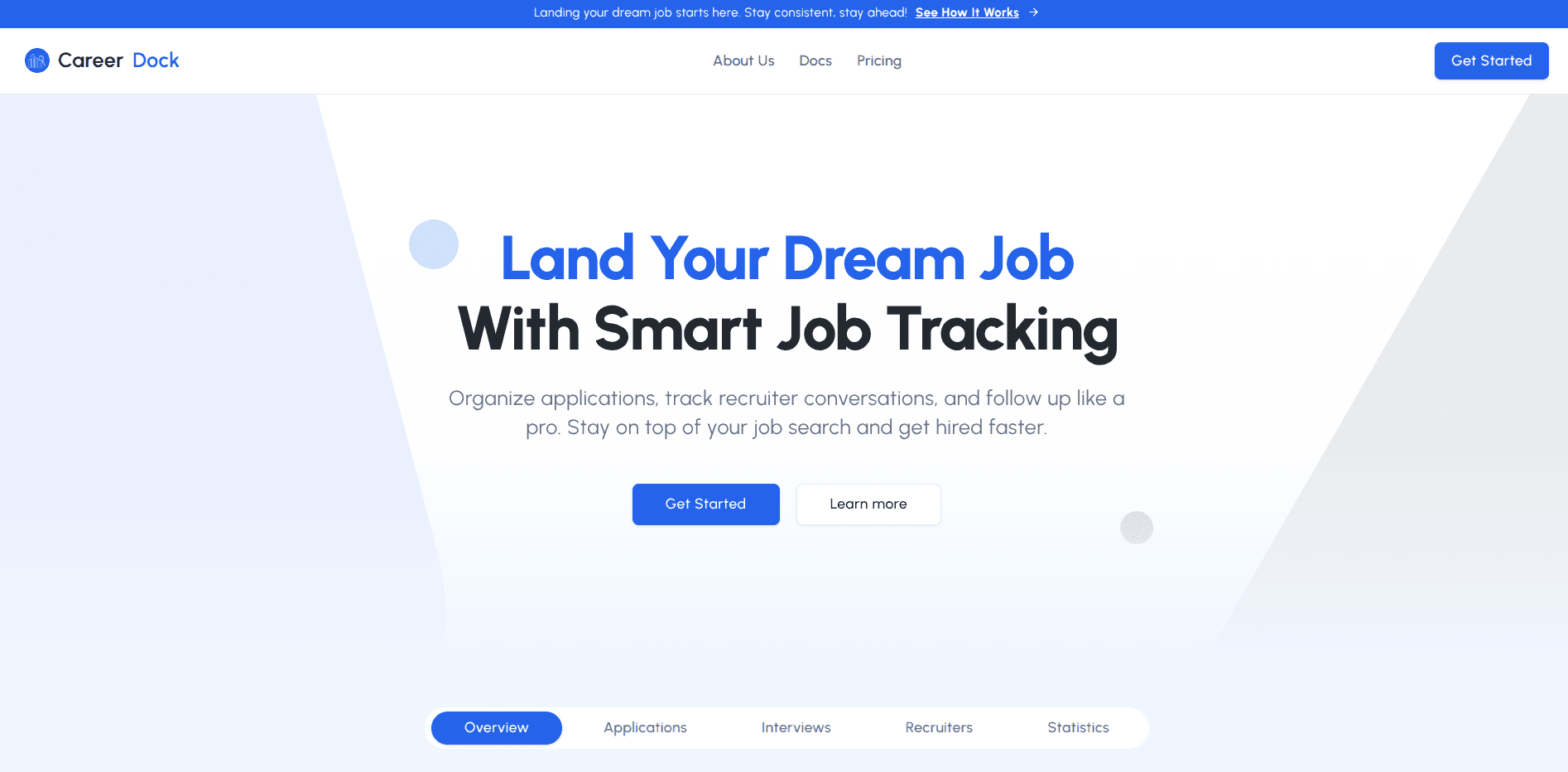
Career Dock started from a simple observation: most job seekers are forced to manage their career process across too many disconnected tools. They write resumes in one place, track applications in a spreadsheet, save recruiter notes in another app, and lose momentum because the workflow is fragmented. I wanted to turn that scattered routine into one focused product.
Project type
Live SaaS
Year
2025
Challenges
3
Tech used
9
What Problem It Solves
Career Dock solves the operational side of the job search. Instead of treating resume writing, recruiter follow-up, interview preparation, and application tracking as separate tasks, the platform brings them together into one system so users can stay consistent, reduce context switching, and make better decisions from their own data.
Why I Built It
I built Career Dock because I saw how stressful and repetitive the job search can become, especially for candidates applying at scale. People do not only need AI-generated content. They need structure, visibility, and a workflow that helps them keep moving. I wanted to build a product that felt useful every single day, not just at the moment a resume is generated.
Why This Tech Stack
I chose Next.js and TypeScript for a fast product experience, maintainable code, and strong SEO foundations. Express.js and MongoDB gave me flexibility to evolve the data model as the platform grew from a simple concept into a broader career management system. Clerk handled authentication reliably, Lemon Squeezy made subscription flows practical for a live SaaS, and Gemini AI was a good fit for generating personalized career content inside real user workflows.
Challenges I Faced and How I Solved Them
Making AI output feel useful instead of generic
The first challenge was that AI-generated resumes and emails can easily sound repetitive or overly polished. I improved this by structuring prompts around job context, user goals, and output type so the generation felt more practical and tailored. Instead of treating AI as the product, I treated it as one layer inside a larger workflow.
Designing a product with multiple connected modules
Application tracking, recruiter management, tasks, and analytics all depend on related data. I solved this by keeping the product model centered around the job search journey rather than building isolated features. That made it easier to connect dashboards, reminders, and AI-generated content without creating a confusing user experience.
Balancing growth with stability in a live SaaS
Because the product is already in use, changes could not come at the cost of reliability. I kept the architecture modular, protected key flows like auth and billing, and shipped features in a way that preserved the core experience for existing users.
Outcome
Career Dock became my strongest product case study because it demonstrates more than feature development. It shows product thinking, AI integration, subscription architecture, and the ability to build for real users. With 100+ active users on the platform, it proves I can turn an idea into a working SaaS that solves an ongoing problem.